Adaptive Spaces
AI Necessitates New Blueprint for Digital Infrastructure
November 3, 2025 3 Minute Read

Artificial intelligence (AI) companies are driving strong demand for data centers across North America that have exceptionally large power capacity to run their applications. As a result, some hyperscale campus developments currently under construction plan to provide more than 1 gigawatt of capacity on a single site.
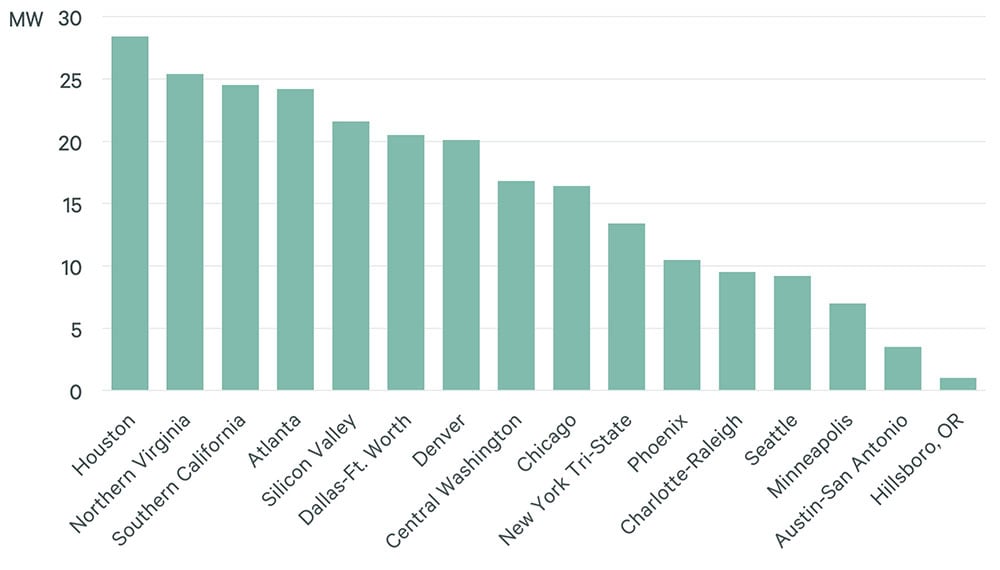
AI occupiers require data centers that facilitate high-density computing, rapid deployment and provide continuous uptime. The biggest challenge to this is readily available power capacity. Even with data center supply increasing by 43% this year in primary markets, the vacancy rate fell to a record-low 1.6%.
Figure 1: Available Existing Power Capacity in Select U.S. Markets
GPU-as-a-Service and Neocloud companies are the next generation of cloud computing providers that facilitate AI and machine learning applications. They leverage specialized processing units to provide fast, flexible and scalable computing resources that support the advancement of AI-driven innovation and digital transformation across various industries.
Many of these occupiers are looking for continuous space of 5 to 20+ MW that is operational within nine months to provide connectivity under a single roof. Power densities are now in the 50-to-100kW+ range, which is changing the cooling design to direct-to-chip or immersion.
Figure 2: Pyramid of AI Needs

For AI occupiers, continuous uptime is critical. Dual feeds, backup generation and uninterruptible power supply (UPS) redundancy are expected. Best-in-class data center operators provide precision maintenance, thermal efficiency and proven operational continuity that deliver continuous power availability.
Enterprises and cloud operators are increasingly drawn to facilities that support modular growth. The ability to rapidly scale power density, expand floor space and transition between wholesale and retail colocation models allows occupiers to align infrastructure with fluctuating workloads. Flexible lease structures—shorter terms, renewal options and turnkey deployments—are key differentiators for today’s landlords.
Carrier-neutral ecosystems and high fiber density remain essential. Customers value direct cloud on-ramps, diverse network routes and low-latency interconnection with major exchanges. Beyond connectivity, compliance with ISO, SOC 2, PCI-DSS, HIPAA and regional data privacy standards is expected. Physical and cyber security standards—24/7 surveillance, biometric access and incident transparency—are critical.
Looking ahead, the next generation of AI occupiers will measure value by the ability to scale, interconnect and sustain at speed. Operators that meet this expectation will define the digital landscape of 2025 and beyond.
Related Insights
-

Data center demand in North America outstrips supply, driving record-low vacancy rates and price increases.

Data Center Solutions
Contacts
Pat Lynch
Executive Managing Director, Data Center Solutions