Adaptive Spaces
Beyond the Desk: How to Design Offices That Draw Employees In
Part 2 of our 2026 Global Workplace & Occupancy Insights series.
February 18, 2026 7 Minute Read
Introduction
Explore More Benchmarking Data
Leverage our office occupancy benchmarking dashboard to enhance decision-making. Customize filters by sector and region.
In the evolving hybrid workplace, the question of "Why come to the office?" is more pertinent than ever. This article dives deep into the forces shaping the future of work, focusing on the crucial role of in-office presence in fostering collaboration and building a thriving community. We explore compelling data points that highlight how the office is transforming from a functional space to a destination—a place employees choose to be—and the key elements driving this shift. From the undeniable importance of collaboration and the impact of design to the reimagined role of amenities and the changing landscape of space allocation, we'll uncover the strategies organizations can deploy to create a compelling and engaging workplace that attracts and retains talent.
The Future of Work Is Human
Connection motivates in-office attendance.
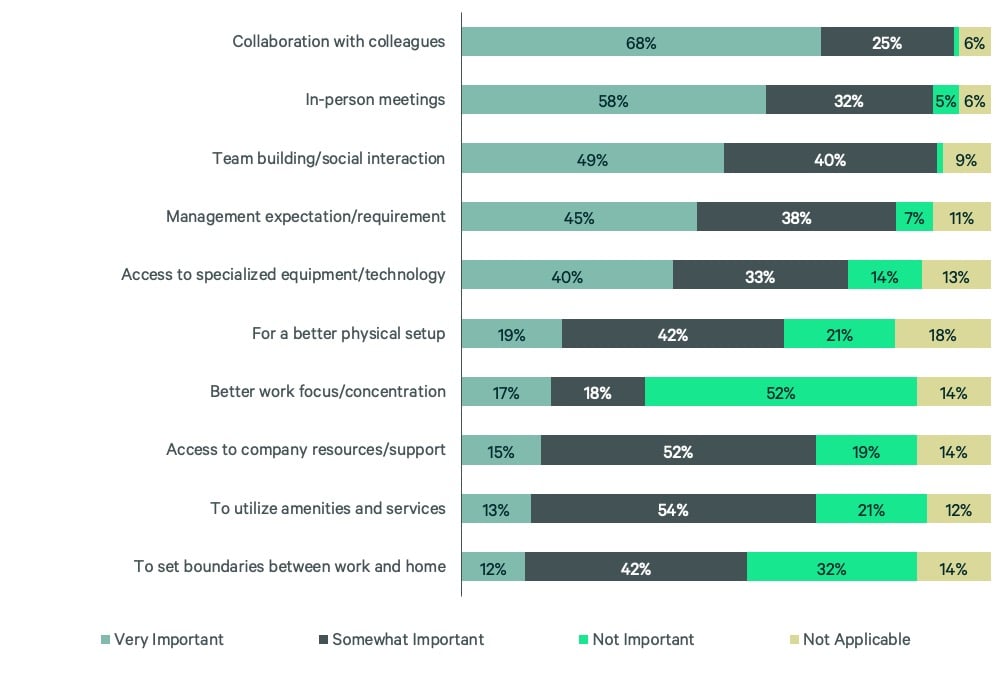
The data speaks clearly: Collaboration and connection are paramount. A majority of employees cite "collaboration with colleagues" (68%) as the most important reason for coming into the office, followed closely by "in-person meetings" (58%). These figures paint a clear picture. The office isn't just a place to do work; it's a place to connect and create. While the ability to focus and concentrate might be important, the social and collaborative aspects of the office are the most critical drivers of in-office attendance. Let’s consider the variety of activities that can fall within the categories of social and collaborative. Social might include anything from team lunches, anniversary or retirement celebrations, employee awards, wellness events or volunteering—all things that create a sense of belonging and affinity between employee and employer. Collaboration might include project work, a 1:1 with a manager or mentor, a training session, a client presentation, an annual strategy session or a daily stand up—all types of work activities that require more than one person, many of which are more effective in person.
Conversely, the data reveals the limitations of focusing solely on individual needs. "Better work focus and concentration" (52%) and "setting boundaries between work and home" (32%) are rated as less important reasons. This suggests that the office's value lies not in replicating the quiet solitude of a home office, but in fostering the vibrant energy of a shared experience. The office isn't just a place to get work done; it's a place to work together.
Figure 1: How important is it to be in the office for the following reasons?
This emphasis on collaboration is further reinforced by the success of office design. A significant majority consider the current office design "very effective" (66%) or "effective" (51%) in promoting social interaction and team building. This success isn't accidental. It's the result of intentional design choices that prioritize interaction and the creation of social hubs.
Amenities as Enablers, Not Drivers
While collaboration reigns supreme, the role of amenities should not be overlooked. The office is becoming a destination, not just for work, but for a richer experience. Increased amenities support this shift, but they are enablers, not drivers.
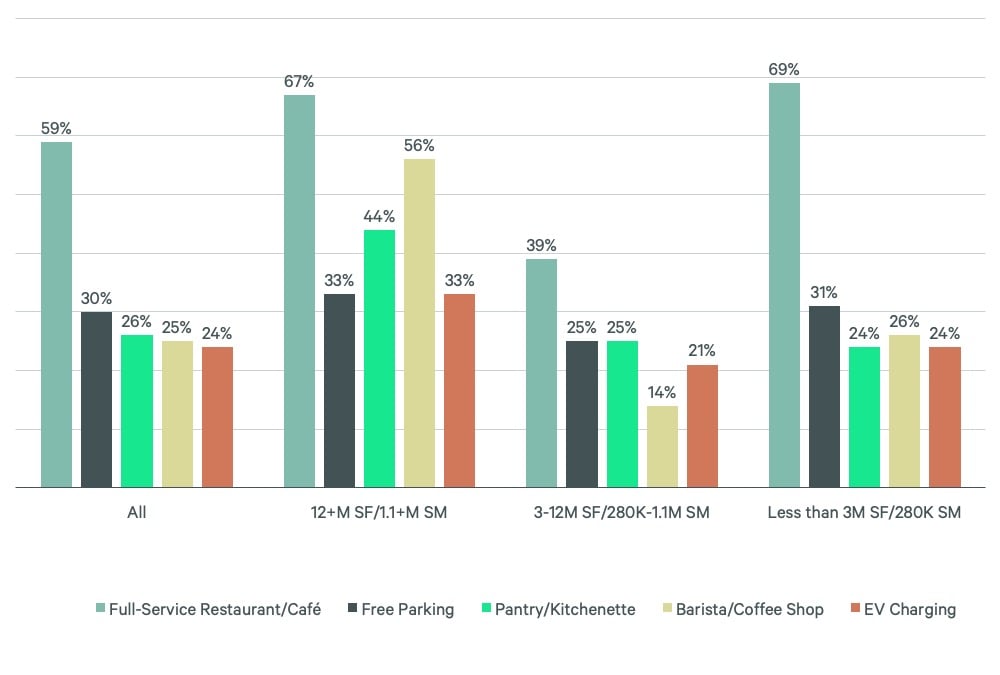
The data spotlights the importance of practical, everyday conveniences. Cafés and restaurants (57%) and less formal pantries and kitchenettes (25%) are major drivers for attracting employees, alongside free parking (29%). These amenities add convenience, saving employees time and reducing friction in their daily routines. They show that employers understand the value of creating a sense of ease and accessibility in the workplace. For example, many employers have increased their food and beverage programming over the past few years, offering events like ice cream socials, hot cocoa bars or wellness Wednesdays in their offices. As an employee who may have the option to work remote or in the office, ice cream may not convince you to drive in, but it’s certainly going to improve your day if you’re already there; it boosts your satisfaction in the physical space.
However, certain amenities are trending down. The decline in importance of multi-purpose space (14%) and wellness (13%) compared to last year's data (both 16% in 2024), reveals a potential shift in priorities. While still valuable, they may be perceived as less critical for attracting employees than fundamental conveniences and cost-saving benefits, especially in light of economic factors or the prevalence of hybrid work models.
Figure 2: Top Five Workplace Amenities
Enjoying This? Follow the Series or Get in Touch
Finding the Right Mix of “Me” and “We” Space
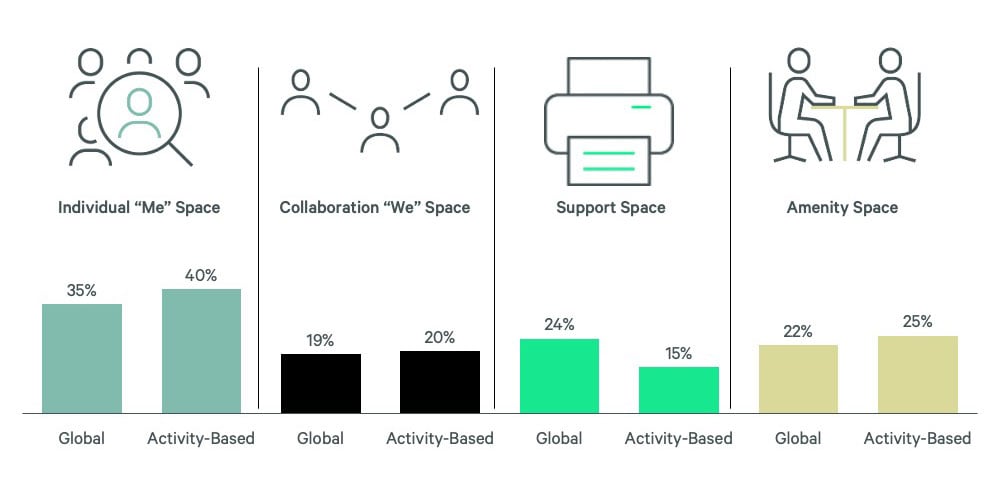
The physical space is undergoing a dramatic transformation, reflecting the evolving needs of the modern workforce. The data reflects a shift to activity-based workplace planning, a design philosophy that prioritizes flexibility and access to a dynamic set of spaces to support a variety of work styles, over an assigned seat for every person. The current space composition (35% Me | 19% We | 24% Support | 22% Amenity) closely mirrors the activity-based model (40% | 20% | 15% | 25%). This trend is not just a passing fad. The majority believe that the activity-based (47%) concept will best represent the future of their clients' offices. This indicates a long-term commitment to designing spaces that are adaptable, collaborative and designed to support a wide range of activities.
Figure 3: How does global space composition compare to Activity-Based Design concept?
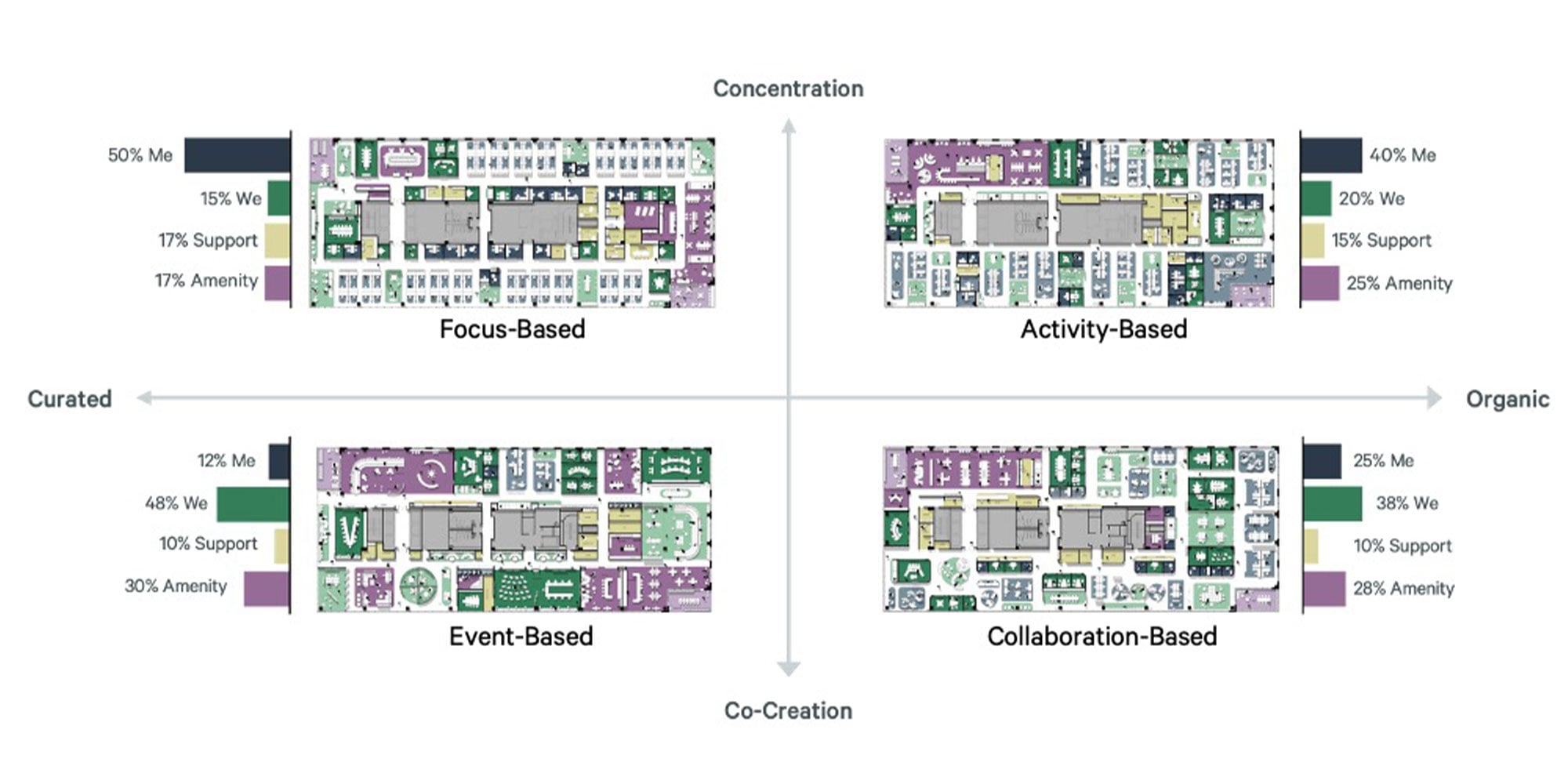
The shift is further reflected in the design concept preferences. A significant change in the design concepts most clients favor: focus-based concepts (42%) dropped significantly from 2024 (71%), while activity-based concepts (40%) saw a substantial increase from 2024 (17%). It's now a relatively even split between focus-based and activity-based.
Figure 4: Workplace Design Concepts
Click to enlarge
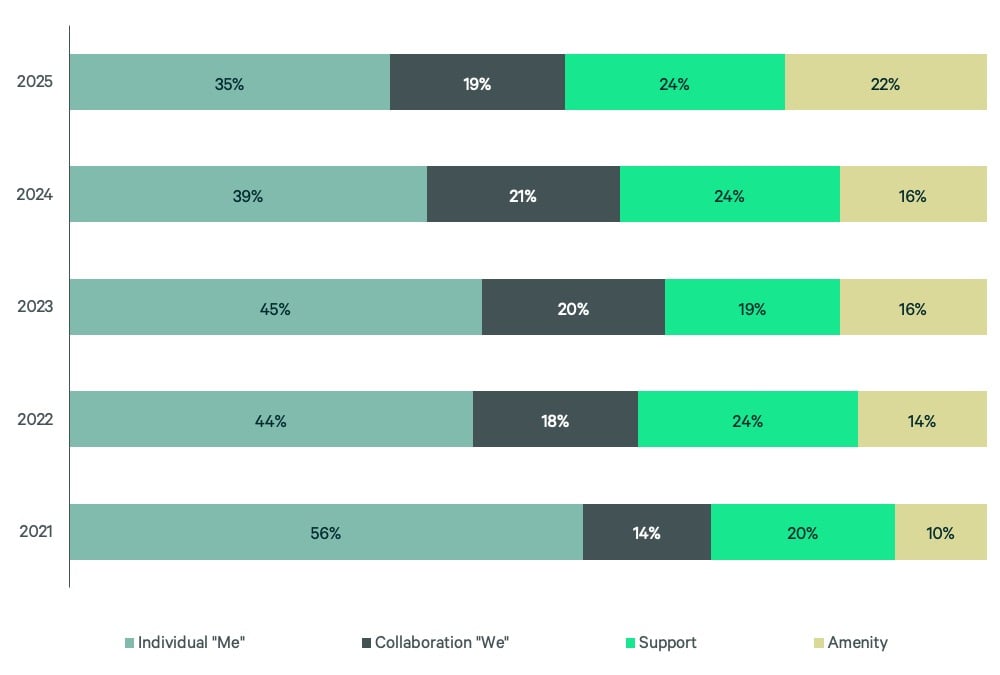
While individual focus space ("Me" space) has steadily decreased to 35% (down from 39% in 2024 and 56% in 2021), collaboration space ("We" space), has experienced its first, though slight, dip in five years, now at 19% (down from 21% in 2024). This apparent contraction of both individual and collaborative areas presents a nuanced challenge: how to effectively balance the needs for focused individual work with the demands of collaborative endeavors. This trend warrants closer examination. Does this signify a temporary fluctuation, or does it signal a need to re-evaluate the balance between focused work and collaborative efforts within the office environment? The answer likely lies in more nuanced design, with the potential for hybrid spaces that effectively support both individual concentration and collaborative teamwork.
Despite the shift toward digital and remote work, support space has surprisingly increased to 24% from 20% in 2021. This seemingly counterintuitive trend can be explained by several factors. The growth of support space likely reflects a greater reliance on technology, IT support and data security, alongside the expansion of e-commerce and its associated delivery volumes. Furthermore, a focus on efficiency, security and the necessity to accommodate specialized equipment and functions, all within the context of supporting a hybrid work model, contribute to this increase. This includes spaces such as printer rooms, copy rooms, mail rooms, IDFs (Intermediate Distribution Frames), furniture storage for events and core operational areas.
Figure 5: Workplace Planning Trends
Inclusivity Starts with Space
The way space is allocated and assigned further reinforces the importance of creating an inclusive and collaborative environment. The data reveals a dichotomy in how space is assigned. While workstyle (53%) is the primary driver for workstation assignments, job title (45%) and band level (42%) still heavily influence the assignment of individual offices. Most individual offices are reserved for "leaders of leaders" (87%), which reinforces a traditional, hierarchical approach.
Figure 6: What criteria determine workspace assignment?
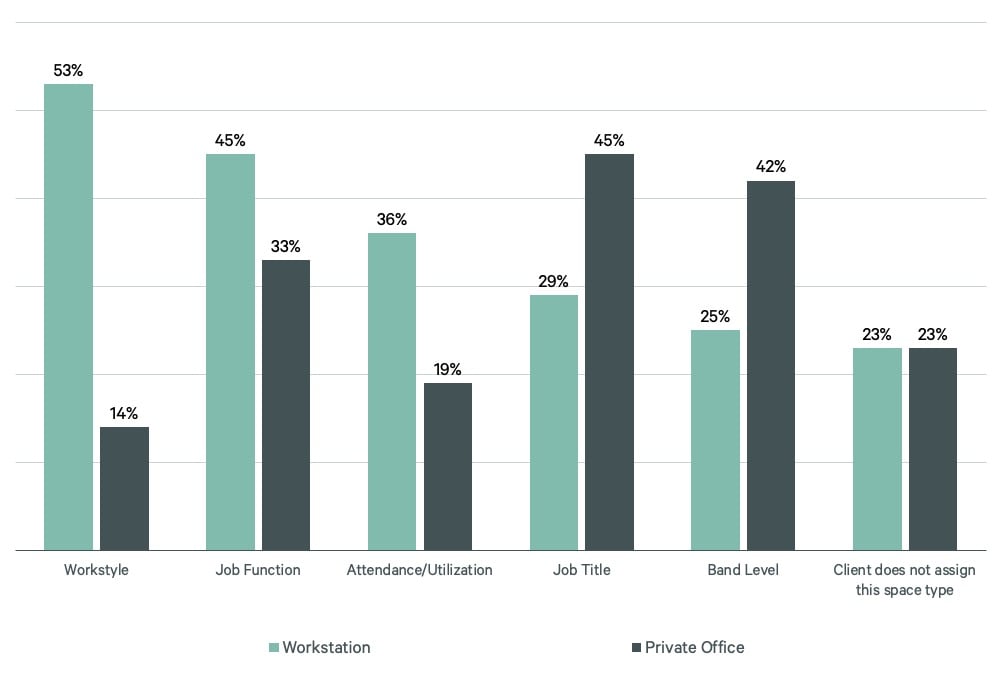
This hierarchical approach, while perhaps unavoidable in some organizations, can inadvertently undermine the sense of community and collaboration that the office strives to foster. It can also be contradictory to the workstyle data that exists for leaders, many of whom travel more frequently and are in more meetings than some of their individual counterparts, which can often lead to assigned private offices sitting underutilized at a higher percent than workstations. In the future, organizations should evaluate whether an equitable application of space assignment could serve to encourage more interaction among all levels of employees. The shift toward activity-based workplace planning and the increasing importance of collaboration highlights the need to re-evaluate traditional hierarchies and create spaces that promote interaction across all levels of the organization.
Building the Destination Office
Designing the Office People Choose
Offices are moving from a place primarily for task execution to a destination—a space where employees choose to be. This shift is driven by fundamental human needs: connection, collaboration, and a strong sense of community. The data unequivocally underscores this, revealing that the social and collaborative aspects of the office are the most critical drivers of in-office attendance.
So, how do organizations successfully build this "destination office"? The key lies in proactively designing and cultivating an environment that prioritizes the core needs of the modern workforce. This requires a multi-faceted approach, incorporating several key principles:
- Prioritizing Social Connection: Design spaces that facilitate interaction, encourage teamwork and foster a sense of shared purpose. This means strategically planning spaces that encourage spontaneous interactions, formal meetings and informal gatherings, recognizing that these interactions are the root of innovation and team cohesion.
- Creating a Holistic Experience: Beyond the core functions of work, the destination office must offer a holistic experience that supports employee well-being, provides convenience and cultivates a strong sense of belonging. This involves investing in amenities that cater to a range of needs, from physical and mental wellness to practical conveniences that streamline daily routines.
- Embracing Flexibility: The one-size-fits-all approach to the office is obsolete. Successful destination offices embrace flexibility by adopting activity-based workplace planning, catering to diverse work styles and evolving needs. This includes providing a variety of spaces to accommodate focused individual work, collaborative projects and everything in between.
- Fostering Inclusivity: Traditional hierarchies can inadvertently undermine an organization’s sense of community. The destination office is designed to promote interaction across all levels of the organization. This requires a conscious effort to break down barriers, create opportunities for informal networking and ensure that all employees feel valued and connected.
By focusing on these key principles, organizations can transform their offices into vibrant hubs of collaboration, innovation and community, where employees not only work, but thrive. The office of the future is not just about getting an assigned desk and free snacks. Forward-looking companies are building a place where people want to be, that reflects the culture and values of the company and embodies the best of human connection and collective achievement.
Conclusion
The data paints a clear picture: The future of the office is intrinsically linked to the power of human connection. While the evolution of the workplace continues, the core motivation for in-office presence remains rooted in collaboration and community. Organizations that understand this shift will be best positioned to thrive. By focusing on the employee experience through thoughtful design, embracing flexibility and cultivating a sense of belonging, businesses can transform their offices from workspaces into vibrant destinations. This means prioritizing social interaction, investing in desirable amenities and fostering inclusivity. Ultimately, the successful office of tomorrow will be a dynamic ecosystem, a hub for innovation, a symbol of culture and vision and a place where employees actively choose to be—a testament to the enduring value of human connection in the modern age.
About the Series
CBRE’s 2026 Global Workplace & Occupancy Insights is a four-part series that explores the hybrid workplace, offering a data-driven roadmap for organizations adapting their real estate, operations, and culture. It covers recognizing hybrid's evolution, designing a connected employee experience, aligning leadership and employee expectations, leveraging AI and technology for space optimization, and preparing CRE professionals for the future of work. The goal: building a thriving hybrid workplace.
Methodology
The 2026 Global Workplace & Occupancy Insights summarize five years of office benchmarking and sentiment surveys on how CBRE clients have adapted their office environments since 2021. The study examines global data from CBRE clients representing 303 million sq. ft./28 million sq. m., with an average office portfolio size of 5 million sq. ft., and delivers insights by portfolio size, industry/sector and region/geography.
Enjoying This?
Subscribe to see what’s next in the series, or get a conversation started with us!
Contacts
Susan Wasmund
Executive Managing Director, Global Occupancy Management, Americas Consulting Accounts

Emily Botello
Managing Director, Americas Consulting

More From This Series
-
Article | Adaptive Spaces
The Affiliation Imperative: The Office’s New Purpose—What the Data Shows
July 16, 2026
Office utilization jumped 15 percentage points in one year—and connection, not mandates, drove the increase.
-
Article | Adaptive Spaces
Data at the Heart of Hybrid: Leveraging AI & Tech to Optimize the Workplace
March 24, 2026
The path to smarter workplace strategy runs through data quality.
-
Article | Adaptive Spaces
The Hybrid Reality: Why the Office Is More Important Than Ever
January 20, 2026
Transforming any workplace into a dynamic hub for collaboration and connection is a challenge. Explore how some organizations are optimizing space.
-

This year, our series offers a data-driven roadmap to help organizations adapt to today's hybrid workplace, covering design, leadership, technology and the future of work.
Related Services
- Manage Properties & Portfolios
Occupancy Management
Leverage occupancy data to empower, anticipate and unlock opportunities within your portfolio.
- Plan, Lease & Occupy
Workplace Strategy
Build resilience, attract and retain talent, and foster connection and collaboration in your workplace.
- Transform Business Outcomes
Consulting
Gain comprehensive guidance on insightful, executable real estate strategies for both investors and occupiers.
- Plan, Lease & Occupy
Organizational Change & Transformation
Enabling organizations to achieve outcomes, improve performance and create change-ready cultures.